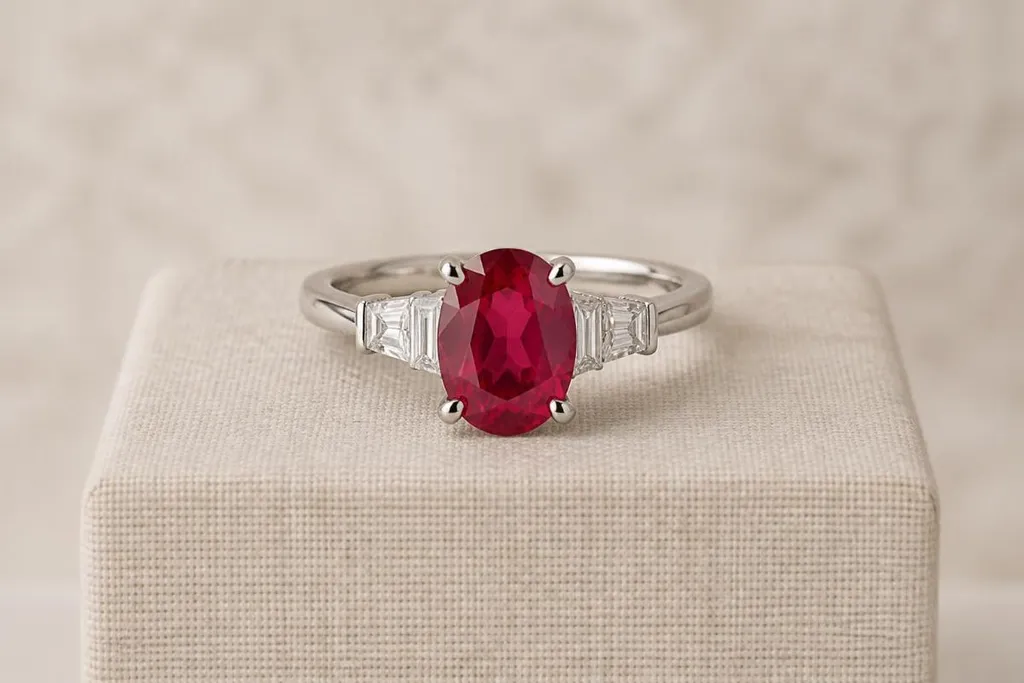
Ruby does not disappear quietly into an engagement ring design. Its red colour immediately becomes the focal point, bringing warmth, depth and a sense of occasion that colourless stones express very differently. Yet despite that bold first impression, ruby is far from a novelty choice. Its history in fine jewellery gives it an established character that can work equally well in traditional and contemporary settings.
For couples considering timeless lab grown ruby engagement rings, the appeal lies in combining that enduring red colour with modern gemstone creation. Lab-grown rubies share the essential chemical composition and crystal structure of ruby, offering the distinctive properties of corundum in a laboratory-created stone. Choosing the right ring then becomes a question of colour, cut, proportion and how the setting supports the gemstone.
Why Ruby Red Makes Such a Strong Centrepiece
Ruby is the red variety of corundum, the same mineral family as sapphire. Its colour can range across different shades and intensities of red, and those variations have a significant influence on the personality of an engagement ring.
A rich, saturated ruby creates a dramatic focal point, particularly when contrasted against a cool white metal or colourless accent stones. A brighter red can feel fresher and more contemporary, while deeper tones often produce a more traditional fine-jewellery effect.
Colour should therefore be chosen visually rather than according to the assumption that darker automatically means better. An engagement ring is seen in daylight, warm interiors and evening conditions, so it is worth considering how the ruby appears across different lighting environments. Unlike a colourless centre stone, ruby can create substantial presence without relying entirely on size. Even a relatively restrained gemstone can become the dominant feature because its red colour separates it immediately from the surrounding metal and diamonds.
Shape and Proportion Influence the Colour
Cut determines how a lab-grown ruby presents both its outline and its colour.
Oval cuts provide graceful length and can create generous coverage along the finger. Cushion shapes offer softer corners and a fuller silhouette, making them particularly effective in romantic or vintage-inspired settings. Round stones provide familiar symmetry, while emerald-style cuts introduce stronger geometry and broader areas of visible colour.
Carat weight needs to be considered alongside dimensions. Someone may prefer a 2-carat ruby because a larger surface allows the red to play a stronger role in the overall composition. Another wearer might deliberately choose a smaller centre stone surrounded by diamonds, allowing contrast to create the impression of greater visual presence. Neither strategy is inherently superior. The right proportion depends on the hand, band width and intended character of the ring.
Setting and Metal Can Transform the Ruby
A solitaire allows ruby red to dominate without interruption. This can produce a surprisingly modern engagement ring, particularly with a clean band and restrained setting.
Diamonds introduce a different aesthetic. A halo of colourless stones creates a bright border around the ruby, intensifying the contrast between red and white. Diamond-set shoulders continue that effect along the band, while a trilogy setting can place the ruby between two complementary side stones for a balanced, substantial composition.
Metal choice changes the colour relationship again. Platinum and white gold provide a cool backdrop that can make red appear especially vivid. Yellow gold creates warmth and a more traditional contrast, linking naturally with ruby's historic fine-jewellery character. Rose gold offers a softer tonal pairing in which the band and gemstone feel more closely related. The decision is less about finding the “correct” metal and more about deciding whether the setting should contrast with or complement the ruby.
Ruby Is Well Suited to Regular Wear
An engagement gemstone must offer more than visual appeal. Ruby ranks 9 on the Mohs hardness scale, giving it strong resistance to scratching and making it a practical coloured gemstone for jewellery worn frequently.
That does not make a ruby ring immune to damage. Hard knocks can still affect the stone or setting, so removing the ring during heavy manual activities remains sensible.
Everyday products such as hand cream and soap can also leave residue around the gemstone, reducing its brightness. Appropriate gentle cleaning helps maintain its appearance, while periodic professional checks can confirm that claws and other setting components remain secure. Wedding-band compatibility is worth considering at the same time, particularly if a close or flush fit between the two rings is important.
Final Thought
Lab-grown ruby engagement rings offer bold colour without sacrificing the qualities expected from enduring fine jewellery. Ruby's established heritage, distinctive red and practical hardness give it substance beyond its immediate visual impact.
The strongest designs allow that colour to lead while keeping every other element in proportion. With a thoughtfully chosen cut, complementary metal and secure setting, a lab-grown ruby can create an engagement ring that feels confidently individual without becoming dependent on passing fashion.